
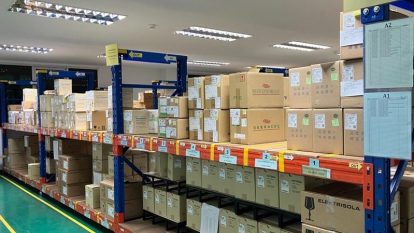
At our Thailand factory, we handle the procurement and storage of various materials used in the production of coils and coil assemblies.
In this article, we’d like to introduce the management methods we use to maintain consistent quality—from material acceptance to warehouse storage and finished product handling.
Material Acceptance Process
Incoming Inspection Using the AQL Method
At our Thailand factory, all materials—whether imported from overseas or purchased domestically—undergo incoming inspection based on the AQL (Acceptable Quality Limit) standard.
The AQL method is a statistically based inspection procedure used to determine the acceptability of a production lot.
It defines the threshold below which a lot is considered acceptable (“if the defect rate is below this level, the lot passes”).
When 100% inspection is impractical, this method is used to decide the pass/fail status of a lot.
Following the Japanese Industrial Standard JIS Z9015-1, the sampling size and acceptable defect numbers are determined according to lot size and inspection level.
If the number of defective items exceeds the allowable limit, the lot is rejected.
In such cases, we request replacement materials from the supplier or, upon request, conduct full selection (100% inspection) at our facility, with associated costs charged accordingly.
Material Storage and Management
Label Control and FIFO Storage
Once materials pass incoming inspection, they are moved to the material storage warehouse.
Each box or package is affixed with a management label that includes:
- Material name and part number
- Receiving date
- Invoice number
- Product name in which the material will be used
- Quantity received
After labeling, materials are stored on designated shelves according to a FIFO (First-In, First-Out) system.
Shelf layout and warehouse operation rules are clearly defined to ensure that older lots are used first and material traceability is maintained.
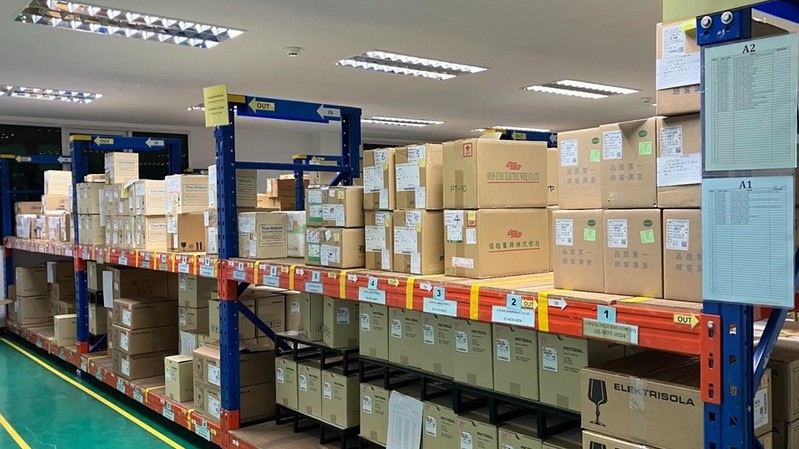
電線(銅線)保管用の棚
Finished Product Storage
FIFO Management After Final Inspection
After in-process inspections on the production floor, finished products undergo final inspection by the Quality Assurance department before being transferred to the finished goods warehouse.
As with materials, FIFO principles are strictly followed.
Products are stored from the rear and retrieved from the front, ensuring that older lots are shipped first.
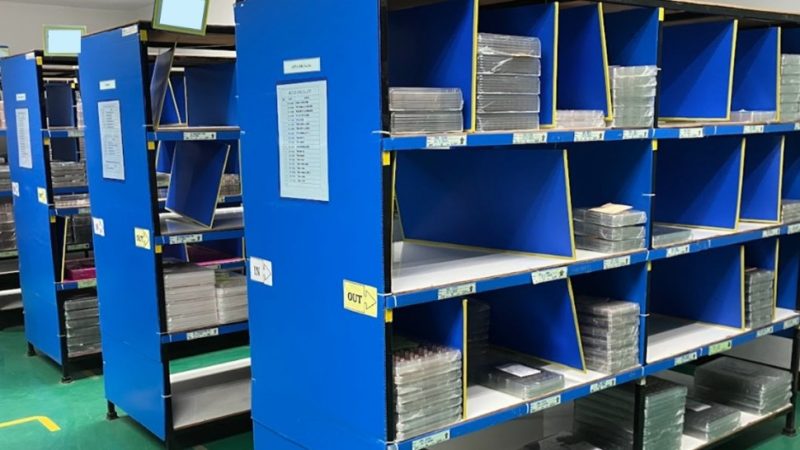
Finished product storage shelves
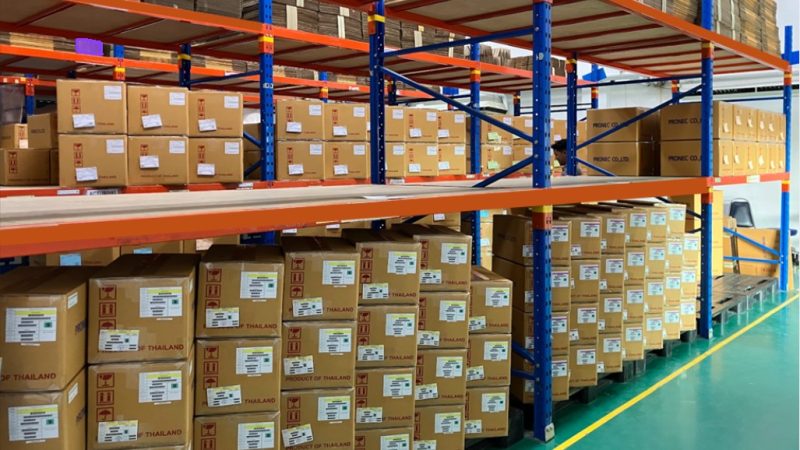
Packed and ready-to-ship product racks
Since PRONEC operates on a build-to-order production system, finished goods are not stored for long periods.
They are promptly packed and shipped according to the delivery schedule.
Summary
This article introduced how PRONEC’s Thailand factory manages materials and products—from incoming inspection to pre-shipment storage.
Through strict AQL inspections, FIFO-based control, and lot-level traceability, we maintain stable product quality and build a production system that our customers can rely on.
For inquiries about coil or coil assembly quality management and production, please feel free to contact us.